Not long ago, this author had a revelation of something so blatantly obvious that he was surprised to have never heard it presented. Not to say that it is a subject which has not been noticed, but analysis seems to be lying dormant in the archives of academic literary criticism, gathering dust and pedantic commentary in online messaging boards. Here, there be other dragons.
So what is this "obvious truth"? It's something upon which the religious among us will object, but the case must be presented; declared absolution of guilt from any hurt feelings.
Satan and Prometheus are the Exact. Same. Person. One is the eternal villain, one the perpetual martyr. One bad, one good, although that may depend on perspective. One is regarded by serious followers of the Abrahamic religions as a factual entity, where the other is laughed off as a mythological trope. But looking at the two characters, there is no question that the Devil is derived from the Titan Prometheus himself.
First, let's begin this claim by ignoring the contextual differences between a polytheistic and monotheistic religion. Although the existence of the devil & demigods challenges the "mono" of... well.. monotheism, if you really think about it. Instead, examine the attributes of the character.
A Fallen Demigod
Satan famously started out as the "Morning Star", Lucifer, one of God's angels in Paradise Lost. It is understood in Biblical texts that "Lucifer" became "Satan" after his fall from heaven-- he then proceeds to such villainy as tempting Eve and projecting doubts to Christ. At some point prior to the Fall, the Devil decided that he did not want to be subjugated by God and his Son, and that it might be "better to reign in Hell than serve in Heaven." It seems that Lucifer just wanted to live free-- a Patrick Henry of the clouds. So he leads an American Revolution of the Heavens, loses (no help from the French, probably), and is condemned to live in Utah. Err, Hell, that is.
Prometheus, on the other hand, was not one of the many Gods of Mount Olympus but instead a child of the predecessors & competitors to the Olympian Gods, the Titans. Prometheus was NOT cast into Tartarus with other Titans, as he chose the right team and did not side against Zeus in the uprising against Kronos & the Old Gods. Other Titans & children of the Titans fared far more poorly-- for example, Atlas had to literally carry the weight of the heavens on his shoulders for all of eternity.
Betrayal of the Big Cheese on the Behalf of Man
Prometheus, either to spite Zeus or for love of mankind, stole fire for the heavens so that men could warm their homes and cook their meat.
Satan, it will be argued, condemned us to suffer outside of Eden after tempting Eve with the apple from the tree of wisdom. But wisdom is a gift if ignorance is a curse; to argue otherwise seems... ignorant.
Satan was Lucifer in heaven, and he "became" Satan after his fall; interestingly, this means that an angel-- a subservient being, presumably created by God-- became the embodiment of evil and temptation. The name "Lucifer" betrays the Greek roots in Christian mythology. "Lucifer" in Latin means "The Morning Star", or as an adjective, "Light Bringer". So Satan, before his punishment, brought light instead of fire.
But as any good Christian would point out, it was "God" who said "let there be light" and saw that "it was good". So in that case, what was the light that Lucifer was bringing? Perhaps the kind of light that might warm homes and cook meat? A light called fire?
Punishment for Betrayal
Prometheus was sentenced to being chained to a mountaintop for the end of time. There, an eagle would come each day and eat his liver. Then, overnight, his liver would regrow, like Wolverine from the X-Men, to be eaten horrifically the next day.
Satan, on the other hand, was cast out of heaven and condemned to Hell, a place that's just awful because you don't get to fawn over God and Jesus and friends. But ignoring a few recent "soft Hell" submissions from apologist ideation, most descriptions of Hell utilize fire, brimstone, and ironic forms of sadistic punishment on those who sinned in life. Hell is a place akin to the torture of the eagle.
Eventually Zeus, growing soft as years went by, relented on Prometheus' torture and sent Heracles to rescue him and shoot the eagle with his arrows, dipped in the poisonous blood of the Lernaean Hydra. God, on the other hand, has not seemed to forgiven the Devil for his war against Heaven (or whatever).
So Zeus, usually described as both capricious and jealous, is apparently a softer deity than Yahweh.
More Punishment: Femme Fatale
Here the chronology differs, but the essence stays eerily similar.
Prometheus:
Before Zeus softened up, he knew how to hold a grudge, and felt that mankind needed to suffer for Prometheus' gift of fire, a gift that could not be revoked once given. So he devised a "gift": a wife named Pandora, the first woman. She was given to Epimetheus, Prometheus' brother (who somehow sounds like a human being... don't ask) to be his bride. Zeus made sure that she was given all sorts of gifts from the other Olypmian Gods-- including curiosity. Zeus also gave Epimetheus a box (or, originally a jar) containing all the Evils of the world that would never plague mankind-- they were under his protection. Pandora was told to, you know, stay away from the thing.
Naturally, the curious Pandora could not help herself, and one night she opened the box. Out exploded all the evils of the world-- famine, disease, plague. Pandora slammed the box shut, and a small voice from inside cried "Let me out too! For I am Hope!" Hope had been locked up with the other evils, to provide for humanity against all the other ills. Whether Hope makes it out or is stuck in the Box is never explicitly said, and depends on how pessimistic your interpretation might be. Or you might consider Bane from The Dark Knight Rises, who claimed that no true despair can exist without Hope.
Abrahamic Religion:
Eve is created by God from one of Adam's ribs (a reference to a condition where women sometimes, not always have one extra set of ribs-- approximately 0.2%-0.5% of the population, most being women).
God does this to keep Adam company, because being single is terrible. So while they're chumming around the Garden of Eden, they've been forbidden from eating from the Tree of Knowledge. A serpent suggests to Eve that she should, and curiosity and innocence get her-- she eats of the fruit, and has Adam do the same. And they are cast out of the Garden of Eden, into the cold, harsh world. In this case, Satan is doing the tempting, but it is God who punishes the formerly innocent (who realize their nakedness) and banishes them from paradise on Earth.
To Be Continued....
So what is this "obvious truth"? It's something upon which the religious among us will object, but the case must be presented; declared absolution of guilt from any hurt feelings.
Satan and Prometheus are the Exact. Same. Person. One is the eternal villain, one the perpetual martyr. One bad, one good, although that may depend on perspective. One is regarded by serious followers of the Abrahamic religions as a factual entity, where the other is laughed off as a mythological trope. But looking at the two characters, there is no question that the Devil is derived from the Titan Prometheus himself.
First, let's begin this claim by ignoring the contextual differences between a polytheistic and monotheistic religion. Although the existence of the devil & demigods challenges the "mono" of... well.. monotheism, if you really think about it. Instead, examine the attributes of the character.
A Fallen Demigod
Satan famously started out as the "Morning Star", Lucifer, one of God's angels in Paradise Lost. It is understood in Biblical texts that "Lucifer" became "Satan" after his fall from heaven-- he then proceeds to such villainy as tempting Eve and projecting doubts to Christ. At some point prior to the Fall, the Devil decided that he did not want to be subjugated by God and his Son, and that it might be "better to reign in Hell than serve in Heaven." It seems that Lucifer just wanted to live free-- a Patrick Henry of the clouds. So he leads an American Revolution of the Heavens, loses (no help from the French, probably), and is condemned to live in Utah. Err, Hell, that is.
 |
| From "The Passion of the Christ" |
Betrayal of the Big Cheese on the Behalf of Man
Prometheus, either to spite Zeus or for love of mankind, stole fire for the heavens so that men could warm their homes and cook their meat.
Satan, it will be argued, condemned us to suffer outside of Eden after tempting Eve with the apple from the tree of wisdom. But wisdom is a gift if ignorance is a curse; to argue otherwise seems... ignorant.
Satan was Lucifer in heaven, and he "became" Satan after his fall; interestingly, this means that an angel-- a subservient being, presumably created by God-- became the embodiment of evil and temptation. The name "Lucifer" betrays the Greek roots in Christian mythology. "Lucifer" in Latin means "The Morning Star", or as an adjective, "Light Bringer". So Satan, before his punishment, brought light instead of fire.
But as any good Christian would point out, it was "God" who said "let there be light" and saw that "it was good". So in that case, what was the light that Lucifer was bringing? Perhaps the kind of light that might warm homes and cook meat? A light called fire?
Punishment for Betrayal
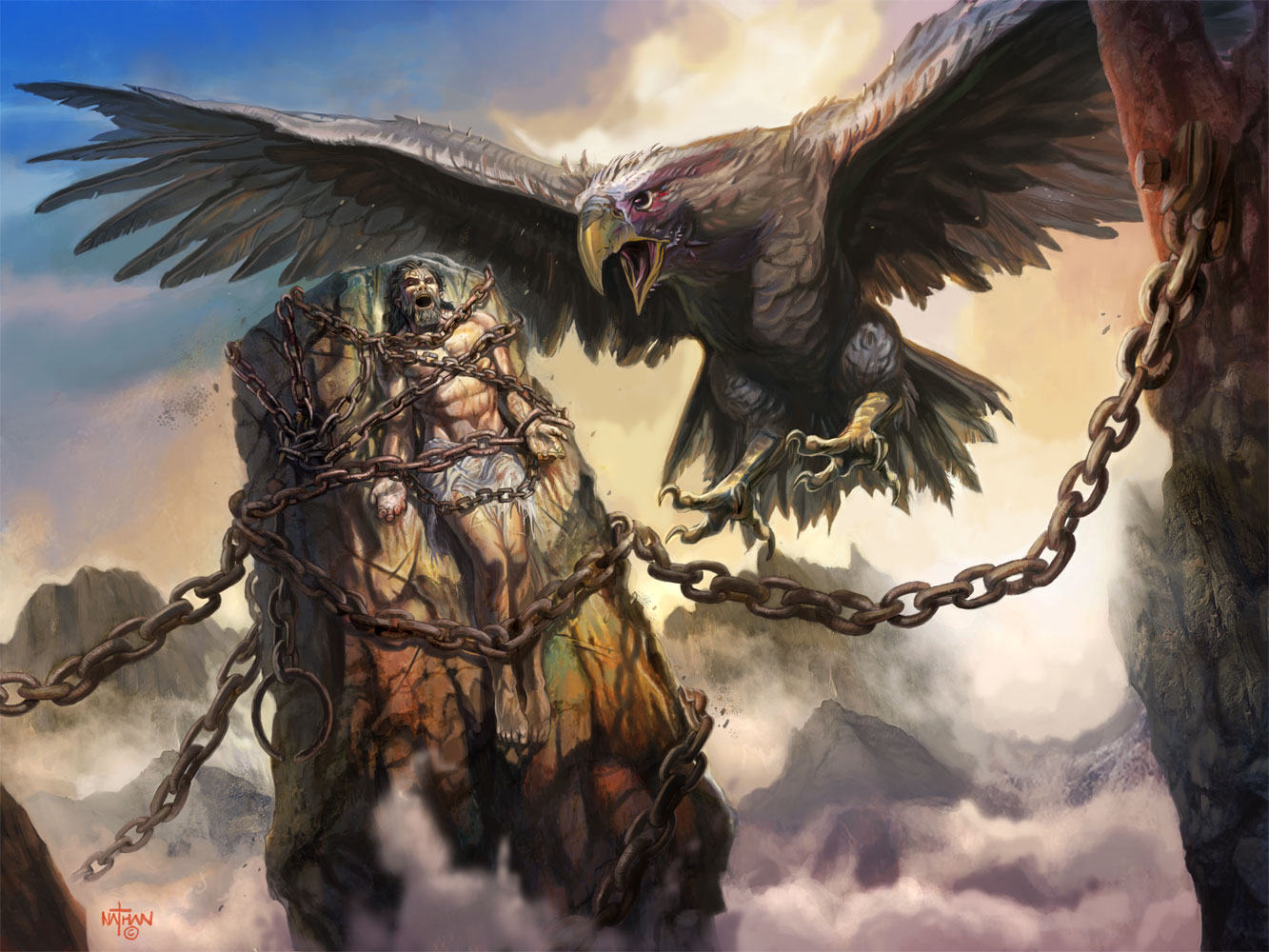 |
| "Prometheus Chained" by Nathan Rosario |
Prometheus was sentenced to being chained to a mountaintop for the end of time. There, an eagle would come each day and eat his liver. Then, overnight, his liver would regrow, like Wolverine from the X-Men, to be eaten horrifically the next day.
Satan, on the other hand, was cast out of heaven and condemned to Hell, a place that's just awful because you don't get to fawn over God and Jesus and friends. But ignoring a few recent "soft Hell" submissions from apologist ideation, most descriptions of Hell utilize fire, brimstone, and ironic forms of sadistic punishment on those who sinned in life. Hell is a place akin to the torture of the eagle.
Eventually Zeus, growing soft as years went by, relented on Prometheus' torture and sent Heracles to rescue him and shoot the eagle with his arrows, dipped in the poisonous blood of the Lernaean Hydra. God, on the other hand, has not seemed to forgiven the Devil for his war against Heaven (or whatever).
So Zeus, usually described as both capricious and jealous, is apparently a softer deity than Yahweh.
More Punishment: Femme Fatale
Here the chronology differs, but the essence stays eerily similar.
Prometheus:
Before Zeus softened up, he knew how to hold a grudge, and felt that mankind needed to suffer for Prometheus' gift of fire, a gift that could not be revoked once given. So he devised a "gift": a wife named Pandora, the first woman. She was given to Epimetheus, Prometheus' brother (who somehow sounds like a human being... don't ask) to be his bride. Zeus made sure that she was given all sorts of gifts from the other Olypmian Gods-- including curiosity. Zeus also gave Epimetheus a box (or, originally a jar) containing all the Evils of the world that would never plague mankind-- they were under his protection. Pandora was told to, you know, stay away from the thing.
 |
| http://www.cgarena.com |
Abrahamic Religion:
Eve is created by God from one of Adam's ribs (a reference to a condition where women sometimes, not always have one extra set of ribs-- approximately 0.2%-0.5% of the population, most being women).
God does this to keep Adam company, because being single is terrible. So while they're chumming around the Garden of Eden, they've been forbidden from eating from the Tree of Knowledge. A serpent suggests to Eve that she should, and curiosity and innocence get her-- she eats of the fruit, and has Adam do the same. And they are cast out of the Garden of Eden, into the cold, harsh world. In this case, Satan is doing the tempting, but it is God who punishes the formerly innocent (who realize their nakedness) and banishes them from paradise on Earth.
To Be Continued....

No comments:
Post a Comment