Wednesday, September 25, 2013

In Defense of Speciesism

From http://www.filemagazine.com/thecollection/
The vegetarian community can be safely assumed to be a substantially liberal. This assumption I make without citation, but it is self-evident from the cultural zeitgeist, identifiable leanings of organizations such as PETA, and the absence of a modern conservative archetype known to adhere to vegetarian or vegan diet. In reality, no obvious dogma prevents the most conservative, evangelical, gun-loving, hard-right winger from becoming an enthusiast of the Whole Foods produce aisle and stir frying every known recipe of tofu. But the thought of Ted Nugent picking that lifestyle up seems absurd.

Sure, Hitler was a right-wing vegetarian. Most vegetarians are not Hitler.

            Meanwhile, the liberal stance in American politics squarely sits in support of gay marriage and the repeal of legislation such as The Defense of Marriage Act (DOMA), the woeful legislative compromise signed into law by President Bill Clinton. Other advances on this agenda have been made under the Obama administration, such as the repeal of the “Don’t Ask, Don’t Tell” policy which required even greater sacrifice from gay American soldiers than is already required by their service. This is an encouraging step for gay rights activists, and while progress may be slower than liberals desire, progress it is.

            Moreover, several states have begun recognizing the legal right to gay marriage. This allows same-sex couples to enter the same union that is recognized by the government--a union that must be agnostic to religious dogma if it is to respect the First Amendment and particularly the non-establishment clause. An occasional counterargument from opponents to gay marriage is that “Freedom of Religion is not Freedom FROM Religion.” This is a direct assault on a quickly growing, and equally valid segment of the population: the agnostic, atheistic, humanist and free-thinking individuals amongst us. These individuals do not demand that God delivered morality to be deciphered and disseminated by a lucky few religious elite, but that ethics and morals come to us as innately and intrinsically as the ability to speak or walk.

            Using consistency of reason and thoughtful assembly of ethical principles is essential in a free and moral society. Without deliberate and reflective moral pondering, the absence of discrete transcendent authority does leave the danger of a poor moral compass --a danger not remotely alleviated by erroneous claims of heavenly knowledge. The requirement to personally create ethical boundaries will produce better results than those relying on non-existent heavenly command.

            It is the quest for moral consistency that disrupts my ability to support the ethics-based vegetarianism.

            The bridge between the morality of gay marriage and vegetarianism requires two assumptions: first, we are mammals, primates—the descendants of evolutionary and ordinary biological processes. Should I lose half the country with that first assumption, but so be it-- the scientific community supports my assumption.

The second and more cumbersome assumption is that while human beings may be animals, human life and other animal life cannot be held with the same moral regard. This is obvious at least on a certain level-- even the gentlest vegan will at some point accidentally trample an ant with his or her bare feet and not need suffer cries of (conveniently named) manslaughter. It would be enormously surprising if the most organically-minded beatnik could shrug off a mouse or roach infestation in their food supply. And all this is to ignore all other types of life-- no one bemoans the plants. The degree of sentience and intelligence a being possesses may excuse it from becoming livestock, but cultures will disagree to this point. Dogs of certain breeds are still an acceptable food source in China; Scooby might become the snack itself if he isn’t deemed cute enough. Although pigs have shown intellectual promise comparable to dogs, bacon persists.

Healthy people don’t want to eat their pets. But how do we decide what will make a happy pet and what will make a happy meal?

            Food taboos are clearly and enormously defined by cultural norms and consensus. How do we draw this line? PETA has engaged in a prolonged campaign for tuna meat not to be simply dolphin-safe, but tuna-safe as well. The American culture that abhors Shark Fin Soup will feed its schoolchildren “pink slime”. It is difficult to break down these preferences without entirely arbitrary boundaries.

From the other side of the argument though: was Cruella DeVille really not so bad? What degree of cruelty will we permit animal life to suffer?

And…. how does this come back to gay marriage?

            In 2003, Rick Santorum made comments that referenced the “slippery slope” grounds as a defense against LGBT equality. Columnist and activist Dan Savage at that point began the neologism for “Santorum” in protest—redefining the politician’s last name as “the frothy mixture of lubricant and feces that is sometimes a byproduct of anal sex.” Ouch.

            And Dan Savage was right to object—the entire gay population being compared to the guy in Montana who has sex with his horse? That’s ridiculous, absurd, and insulting.
            
But.

There is a man in Horry, South Carolina who has sex with his horse. A fascinating Internet search will reveal the much longer sordid human history of beastly flings between man and horse, dog, and even octopus.

Still, a horse cannot provide legal consent, so does that render the point is moot? Two gay people can affirm their mutual affection, where the horse-man relationship is not capable of dual confirmation. After all, it’s just a stupid animal.

Here we find a breach in logical consistency—excluding bestiality from sexual liberation requires an entirely different perspective on human beings from what has been previously established. Suddenly it is assumed that we are, in fact, uniquely special—God’s chosen children, so to speak. Let us assume that animals can—in some shape or form—provide consent. Granted, animals probably will not recognize our legal mores and social norms, but it is fathomable that they have sufficient behavioral autonomy to make some choices for themselves—to provide some form of acquiescence. If that can be deciphered, an animal’s will is not so different from a human’s.

And if this is the case, why unconditionally condemn interspecies relationships? Humans have played their hand at controlled interspecies breeding: take the mule or the liger, for example—horses and donkeys create a hybrid similar enough that it offends no one. If phenomena can occur in nature, is it not natural? And are human beings themselves not a part of the natural order? Certainly bestiality is rare—rarer than any other sexuality—at least so far as we could possibly know and safely assume. Nonetheless we could choose to decry it as “unnatural”, “sinful”, “disgusting”, “depraved”, or any other word that comes to mind when this subject comes to mind.

All of these terms and arguments, of course, have been used by the heterosexual majority on the LGBT minority, and that segment of the population has had their behavior and identity suppressed for generations in American society. A recent one-shot comic book story called “Our Love is Real” explores a dystopian (utopian?) future where sexual relationships between humans and animals, vegetables, or crystals are quite ordinary.

It is argued to this day that homosexuality is a choice; the gay population and a growing majority of America disagree. Is it possible that the horse-loving population also claim their attraction is ingrained in their DNA? If not… why do it? Arousal from watching “Seabiscuit” is incomprehensible and revolting to those who do not experience it; the same, again, could be said of gay pornography.

This equivalence is not just disagreeable—it is unacceptable.

The fulfillment, love, and mutual benefit of same-sex relationships are inarguable; society has “evolved” to an era that (while not advancing in lockstep) is growing friendlier to the gay community year by year. Those who claim to know divine truth or tropically argue that “marriage has always been one man one woman” are not only ignoring history (Athens, anyone?) but also sit on the clear losing side of history. The same form of argument (using Biblical endorsement of slavery, for example) has been used to obstruct civil rights in the past; future generations will inevitably look back with disgust.

But any argument is fundamentally flawed if permitting acknowledgement of the first assumption and dismissal of the second. The idea that society should embrace bestiality is laughable, and it is simply not something that is or should be permissible by civilization. Human beings must be held in an elevated regard—a regard that is paradoxically a tad arbitrary based on the first assumption-- but a higher standard nonetheless. Species solidarity must supersede fealty to outside species. We are built as social creatures and both logic and nature demand loyalty to homo-sapien.


To that end, it is not wrong for a human being to eat animal meat; the mass-industrialization of farming may have some unwanted effects, but there can be no doubt that it feeds a hungry population. Once it is accepted that it is far better for one hundred chickens to die than for one human being to starve, this conclusion becomes inescapable. Vegetarianism as a healthy choice is still valid—it is believed (in somewhat spurious calculations and studies) to be energy-saving as well as (less questionably) a healthy lifestyle. But there exists no moral high-ground for the vegan to perch.

Monday, September 23, 2013

The GLBT Package Problem

It stands to reason that GLBT issues are the civil rights cause of the time. Progress has cascaded from the recesses of special interest to a mainstream position of advocacy. Thirteen states that have legitimized gay marriage, a new (and still slight, but growing) majority of Americans support an expansion of rights, and the Supreme Court decision Hollingsworth v. Perry reversed the infamous Californian Proposition 8; these developments have snowballed into a victorious trend. And of the many individuals, institutions and organizations that have won these battles (from Dan Savage  to Andrew Sullivan) should be credited. But one nonprofit stands above the rest, both in terms of brand success and efficacy, and that is the HRC: the Human Rights Campaign.

There's a small complaint though, that might be worth filing against these honorable and decent institutions, and liberal society as a whole. There is a "politically correct" way of referring to, shall we say less tactfully, the gay issue. The token term, the verbiage du jour, the acceptable fragment of lexicon is "the GLBT community". That's all well and good-- broad strokes cover broad territory. But by creating a label-- a brand, if you will-- for the sexual minority, entirely different groups are bundled together. And while these groups have like interests, as time goes on and freedom prevails, there stands a chance that this unwieldly categorization will mask the subtle differences in each group's goals.

What does that mean? Let's take a look.

G(ay) and L(esbian)

As this author sees it, these two parties are closely aligned in their presumptive objectives and goals. These are people who consider themselves homosexual, seeking legal recognition of their rights to pursue their hearts.

The similarities is amplified in part by an accident of history. Were gay rights being explored prior to the vast success of the women's movement, there might be more differences. For simplicity sake, consider when a wife was legally considered tantamount to property for the husband. If this was still the society we were living in, a lesbian relationship would have a clear absence of command; gay men could find themselves in an equally awkward position where patriarchy would need either division or an official decision.

(B)isexual

The Bisexual aspect of GLBT is far more interesting than the Gay or Lesbian, which requires a thought experiment to have any real distinguishable features that are not mutually comprehensive. But consider: a person cannon be monogamously bound to a bisexual relationship! Bisexual, by definition, is a preference or an orientation towards both sexes; but in marriage, there ultimately is only one choice: someone of the same sex, or a different sex. Even if we decided to be creative and consider a third transgender option, monogamy is monogamy.

This, in a way, implies a tacit endorsement of polygamy, which is absolutely not one of the current (or foreseeable) goals of the GLBT movement, so it's interesting that bisexuality is almost always listed along with the others. Certainly individuals identifying as bisexuals need protection of their private choices, and can easily unite with the opposition to sodomy laws. But that is a victory achieved in Lawrence v. Texas, and has diminishing relevance as more and more rights are protected and enabled.

Polygamy is one of the current scare tactics against the GLBT movement by both the religious right and the conservative movement (assuming some fissures between those two entities). The argument that "if we allow gay marriage, why not polygamy?" This is justified further, and not unreasonably so, by religiously permissible history of polygamy in Islam. Mormonism, however, is not usually mentioned due to its semi-Christian nature, although it obviously should be.

(T)ransexual

This topic is the one where I differ slightly from many of my reasonable friends and activists. No doubt a reader could interpret this author's views as slightly "transphobic", and that's probably a reasonably valid criticism. So let me preface with a disclaimer that I harbor no personal malice, and that this is an abstract consideration.

Transexuality involves the surgical switching or the change of identity from male to female, and vice versa. A number of transgender individuals describe feeling "trapped" in a body of the opposite gender. Those willing to commit to the full change may take hormone therapy, undergo surgical procedures, and take on new names and identities.

Personally, this author has no problem with allowing a consenting adult go through the surgery, and while he may feel uncomfortable with that, by no means should any grown person be prevented from pursuing happiness by that account.

However, there have been some recent reports of children assuming different gender identities, and then it does not become a strictly personal decision. There is often an imposing request that the masculinity or femininity of grammar be changed for an individual, for example. While this may be considered a sign of respecting their life choices, it also is requesting that we create some cognitive dissonance: I knew you as a man, now you are a woman, and I will address you as a woman. So your identity has changed. Or was it always a woman, and now I am addressing you correctly, where previously I was mistaken. But you simply were, physically, a man, and using the opposite gender can be found insulting quite easily as well.

This is further complicated by using children; could a doctor follow the Hippocratic oath faithfully while giving, say, an eight-year-old child a sex reassignment? What if they are "certain" of their choice? It seems extraordinarily difficult, and while I doubt caprice is common, it's not unthinkable. If you think this is just alarmist talk, read the case of David Reimer and the unfortunately named Dr. John Money.

Then, of course, there is something that strikes some men in a type of "body horror": the idea of being bamboozled, by being tricked. It's evident in our media from Futurama to South Park to The 40 Year Old Virgin: the accidental romantic entanglement with a transgender person, unaware of that status. If a man or woman feels uncomfortable with having a physical relationship with a person who has gone through a gender transformation, is there a burden on the person who has undergone that procedure to be transparent? Otherwise seems dishonest; actually, dishonesty is difficult to separate from the entire issue, as judgmental as that sounds.

Let's elaborate: consider living in a state where gay marriage is illegal. Two men who identify as men cannot marry. But then, another man has a sex change and can be recognized legally as a woman, and she can marry a man now. As you can see, there is conflict in lumping these groups together, because advancement is not in lockstep between the different communities.

GLBT is a packaging problem, for good causes that are tied but not uniform. Let's hope this is acknowledged, lest a risk that the package may unravel from within.

Tuesday, September 17, 2013

Satan & Prometheus: Different Tongues of the Same Flame (Part 2)

... Continued from Part 1.

To summarize, we have a devious god-entity that rebels against the Chief God, brings a gift to humanity (which, in turn, ultimately curses them) as brought about by a woman.

Are they precisely the same? Yes? No? A little bit? It makes sense if you consider both characters in an evolving mythos, similar to Batman. Comics, TV, animation & film from the 1940's through the 2000's have used the Batman: they capture the same essence but the surrounding mythology adapts to the times. Shark repellent, sadly, will eventually expire.

Different skins of the same Batman, as seen in Batman: Arkham City, showing the different stages in the character's evolution
And Adam West, using Shark repellent

This is not citing Batman for the sake of Batman-- although that is a valid argument, because... Batman. There is a point here.

But imagine: in the 70+ years of exploring America's favorite superhero (sorry Kal-El). The character has been written, discovered, reimagined, revamped and retooled.

Then compare that timescale to the legacy of Greek & Christian mythology/theology: thousands of years in which tales are retold, retooled, perfected. We know that the Romans directly borrowed from the Greeks for their mythologies: the similarities between Zeus and Jupiter are so blaring that no one pretended that were were different Gods throwing different lightning bolts in between civilizations.Some day in the future, perhaps historians will note the way the King James translation of the Bible "borrowed" the same scripture from its Latin, and before that, Aramaic/Hebrew roots.

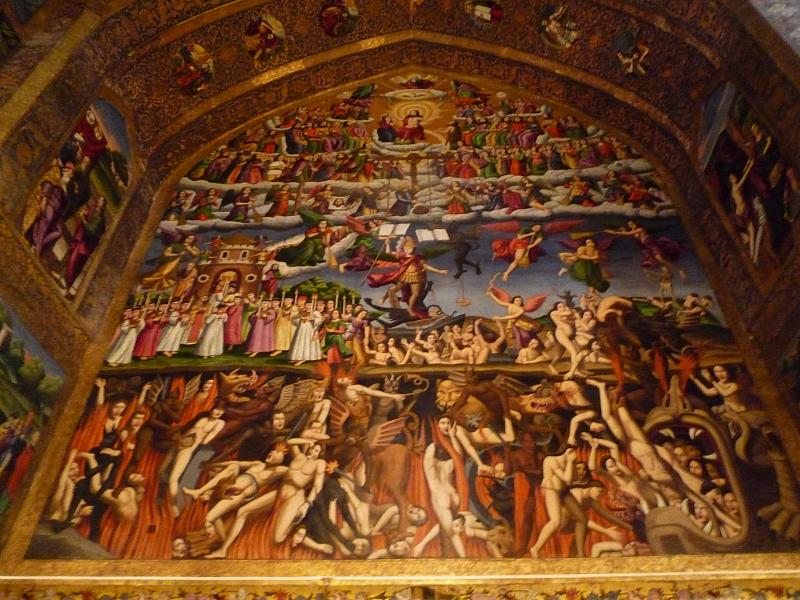
The proof is in the art & literature that is used as Christian poetry. Dante's Inferno has a space for Medusa and the Furies. Figurative poetry for the eternal torments? Perhaps, but does that not tread a dangerous line between fantasy and, er, "reality"? Sisyphus himself, pushing the boulder up an eternal hill, is one of the crisper images that Hell provides. He grossly predates Christianity.

from "http://en.wikipedia.org/wiki/Allegory_of_the_long_spoons"

So what are the implications?

Some Christians, particularly of the Fox News variety, take exception to the God of the Bible being referred to as the same Allah in the Quaran. Why is that? Because the Quaran is not Biblical canon. Similar to the Greek/Roman dilemma, the objection is not raised with Judaism, because Christianity simply added on to the books from the Old Testament, and gives accounts from four apostles.

But if a character from the Bible, which the pious and devout hold to be divine words provided and inspired in Man, are clearly based on fictional mythologies... that is a question that needs to be addressed. Is there a Devil, or isn't there? And if there is not, then why would there be any danger of falling into sin, if sin is as imaginary as its chief harbinger?
http://www.newcovenantgrace.com/how-to-deal-with-a-sin-problem/

The answer is not that there is no morality, nor that we must lose ourselves to the unnavigable seas of moral relativism. Instead, it is more wise and of better moral soundness to embrace the truth of the matter, and appreciate the stories as fables. Few wars have been led over Aesop.

Moral victories are difficult when embracing the "here and now" as the only realm of concern. No cosmic ears to hear our plight, no kindly eyes staring down. But how kindly would deaf ears be, that reject prayers? Were all unanswered prayers too selfish?

But these are victories, once won, worth winning. What is the best, most moral path? Perhaps there are two. Which is the best way north might have different answers, depending on the situation, but there are incorrect answers, such as heading south. Yes, if someone travels south long enough they may reach a place where it is no longer to go further south, and North is the only option (the bottom pole). And that's the point, the proof that cries of relativism are vapid: Sam Harris writes that if there is a polar "worst possible misery for everyone" them any step away from it is a step in the right direction. Sam Harris is walking the right way there.

There may be some who are unconvinced that the alignments that have been outlined are meaningful, or that they're applicable enough to cause a crisis of faith. To that, this question must be answered: what Rosetta Stone must be provided to convince you? What Dead Sea Scroll, what possible Gospel of Judas will prove suitably damning? That is the real crisis of faith: the convergence between an elegant leap and a gullible stumble.

Would a revelation by the authors of the Bible be sufficient? It was Miriam Ferguson who allegedly said in Texas, "If English was good enough for Jesus Christ, it ought to be good enough for the children of Texas." Derided, because clearly this is ignorant in the extreme. This woman, by the way, was governor of Texas, and sadly Texas does not seem to have progressed much further with the likes of Rick Perry. The point being: leaps of faith have a dangerous way of overriding our other faculties, and reducing or level of scrutiny on extraordinarily broad and important claims.

The commonalities overwhelm this author's sense and sensibility, but it may be fair that the case is not compelling to all. After all, Satan tempted Eve after his battles with God, while Prometheus' gift of fire came while he was still on relatively good terms with Zeus. But does it not at least give pause that these events are startlingly similar? Am I the only one who sees this? I FEEL LIKE I'M TAKING CRAZY PILLS HERE!

It's generally regarded as taboo to criticize religious beliefs, but such taboo does not seem to be in place for criticizing mythological tales. So perhaps these analogies can serve as more than filler for a Venn Diagram demonstrating certain correlating attributes. The fundamental elements of the stories need to be examined, and appreciated for what they are; then and only then can they be taken down from the pedestal of Biblical inerrancy. As written on previously, fictional stories hold plenty of value and can teach profound truths. But appreciation of what is fiction-- that is the fruit of the Tree of Knowledge.


Sunday, September 15, 2013

Breaking Bad Recap: Ozymandias

Ozymandias
I met a traveller from an antique land
Who said: Two vast and trunkless legs of stone
Stand in the desert. Near them, on the sand,
Half sunk, a shattered visage lies, whose frown,
And wrinkled lip, and sneer of cold command,
Tell that its sculptor well those passions read
Which yet survive, stamped on these lifeless things,
The hand that mocked them and the heart that fed:
And on the pedestal these words appear:
"My name is Ozymandias, king of kings:
Look on my works, ye Mighty, and despair!"
Nothing beside remains. Round the decay
Of that colossal wreck, boundless and bare
The lone and level sands stretch far away

-Percy Bysshe Shelley

All empires fall. That's the lesson of the poem "Ozymandias", a poem Bryan Cranston used to tease for Breaking Bad season 5 part 2. And boy, have things crumbled.

Ozymandias, the episode, begins with a strange flashback-- Walter and Jesse cooking, way back when they were in the RV. It's unclear exactly when this cook took place; Walt lies on the phone to an unsuspecting Skyler, who is naive to his having quit. There are no bullet holes in the RV. And, to be honest, Walt and Jesse are showing their age, even if their hair is more or less what it was int he early episodes. It's possible it's not meant to be a ;literal flashback, but a corrupted memory of Walter's, where he remembers people half as they are and half as they were. Who knows. The RV, Walt and Jesse disappear, replaced by the trucks and cars in the shootout confrontation from last week's episode.

Cue the Breaking Bad intro.

We find ourselves at the end of the shootout now, and Hank has been hit in the leg. Gomez, it turns out, didn't live to see this episode-- he's been shot dead. His shotgun is nearby, and Hank begins crawling towards it, but it is entirely in vain. Uncle Jack stops him, and prepares to shoot him. Walt objects, of course. He lets Jack know that Hank is his brother-in-law, that he is family, and that he will even pay him an immense amount of money just to not kill him. But no, no such luck. Hank is defiant to the end, correctly reading that Uncle Jack decided to kill him ten minutes ago; Jack is a man who is long past his dilemmas in the basement, deciding whether or not to kill Crazy-8. So is Walt, for that matter, but Walt thinks he can talk his way out of almost any situation. He failed, and he's truly distraught by Hank's dramatic death. Meanwhile, Jesse has gone missing-- but not for long. He is hiding under Walt's car, somehow evading being seen right away.

Jack, after having killed Hank, is naturally still interested in digging up the money, so he does this pretty quickly with his gang of Aryan thugs. They even brought a shovel, as luck would have it. Due to Todd's respect for Walt, and the fact that they want to end things there, they decide to leave Walt one barrel-- something around 11 million dollars, which is enough, right? This is going to make them "square" for the time being-- Walt is ordered to get in the car and drive away. Before he does, he points out Jesse, and reminds them that they never carried out the hit. Todd suggests they take Jesse back with them for all MANNER of unpleasantness and torture, to find out what exactly he told the DEA. Walt consents, but before Jesse can be carted off, he looks at him almost sympathetically. Then he tells him, stone cold, that he watched Jane die, and chose not to save her, even though he could have. Stone fucking cold, man.

In what's clearly a little bit further in the future (and after some beatings and torture, since Jesse let them know everything he had) Jesse is dragged out of the pit he was being kept in. He is unshackled but tied to a makeshift leash that follows a tract on the ceiling in a lab-- he's going to be cooking again, similar to how we was cooking for Gus Fring at the end of that venture.

Walter Jr. has been informed about the crimes of Walter White through the actions of a smug yet sympathizing Marie. Marie demands Skyler erase all tapes that she has of Walt's "confession" framing Hank; she then forces Skyler to tell Walter Jr. everything. He, of course, is upset with everybody. MArie is in the position to do this because, of course, last she knew, Walt was in handcuffs and being taken into custody.

But no, Hank's dead. Shot by the Aryans. We know this, and so it's all the more tragic to watch.

Walt, on his drive home, runs out of gas. This would be a sillier plot point until it's revealed that in the blaze of gunfire, a bullet hit the gas tank, which is now leaking. It didn't explode, it just is leaking; good work, Breaking Bad, the Mythbusters will be happier for a sequel episode. So opening the trunk, Walt realizes he needs to roll the barrel through the desert, where he finally meets a Native American from whom he can buy a truck that's not really for sale. After all, if you can't do that with a barrel full of money, what's the point of having one at all?

At the behest of Marie, Skyler and Walter Jr. drive home, to find a strange car parked there; it's Walt. Walt is packing for them, telling them that they need to get the hell out of town. With everything on the table and Walt's last known whereabouts being in Hank's custody, it's quickly assumed that Hank was murdered by Walt. Walt objects, and asks that they simply, just now, trust him. Skyler grabs a knife, which is a true Chekov knife after being shown in the flashback from the beginning of the episode next to the phone. She tells Walt to get the hell out.

Walt thinks this is a bluff, until she cuts his hand. Then it gets a bit violent, and before we know it they're tumbling in a life-or death fight, until Walter Jr. interjects, protecting his mother and calling the police-- telling them it was WALT who attacked with the knife and that he's gone crazy and may have killed someone. Yikes.

'Walt is angry and defeated-- but not entirely. He grabs Holly before Skyler can realize what he's done, and he drives off with her in the car. Skyler calls the police, since this is now a kidnapping situation. Holly misses her mommy-- blurting out the words "mamma" to break Walt's heart. Walt calls Skyler, and probably knowing that police are there, is absurdly intimidating and threatens to kill her like he killed Hank-- all a show, but probably to keep them safe from legal problems he's caused them all. Eventually Walt decides to sneak into a fire station, star an alarm light and reveal his baby, tucked worriedly in a new car seat. Walt then is shown getting in the van of the mysterious vacuum guy, changing his identity as we knew he would.

Closing Thoughts:

1. Will we EVER see the guy driving that pick-up van, for all the times someone has almost/actually "disappeared" themselves?

2. We knew Hank was toast after he called Marie. Never celebrate too early. But seriously... let's all pour some Schraderbrau on the curb. Respect.

3. Todd is an interesting guy. "I'm sorry about your loss." he says to Walt, after having just orchestrated the execution. Man, don't get in Todd's way. He's not brilliant, he's even courteous, but he's numb to sympathy when you get in his way. He's come a long way from a "B&E" guy at Vamonos Pest.

4. Gomez, we hardly knew thee. But we love you, buddy.

Tuesday, September 10, 2013

Satan & Prometheus: Different Tongues of the Same Flame (Part 1)

Not long ago, this author had a revelation of something so blatantly obvious that he was surprised to have never heard it presented. Not to say that it is a subject which has not been noticed, but analysis seems to be lying dormant in the archives of academic literary criticism, gathering dust and pedantic commentary in online messaging boards. Here, there be other dragons.

So what is this "obvious truth"? It's something upon which the religious among us will object, but the case must be presented; declared absolution of guilt from any hurt feelings.

Satan and Prometheus are the Exact. Same. Person. One is the eternal villain, one the perpetual martyr. One bad, one good, although that may depend on perspective. One is regarded by serious followers of the Abrahamic religions as a factual entity, where the other is laughed off as a mythological trope. But looking at the two characters, there is no question that the Devil is derived from the Titan Prometheus himself.

First, let's begin this claim by ignoring the contextual differences between a polytheistic and monotheistic religion. Although the existence of the devil & demigods challenges the "mono" of... well.. monotheism, if you really think about it. Instead, examine the attributes of the character.

A Fallen Demigod

Satan famously started out as the "Morning Star", Lucifer, one of God's angels in Paradise Lost. It is understood in Biblical texts that "Lucifer" became "Satan" after his fall from heaven-- he then proceeds to such villainy as tempting Eve and projecting doubts to Christ. At some point prior to the Fall, the Devil decided that he did not want to be subjugated by God and his Son, and that it might be "better to reign in Hell than serve in Heaven." It seems that Lucifer just wanted to live free-- a Patrick Henry of the clouds. So he leads an American Revolution of the Heavens, loses (no help from the French, probably), and is condemned to live in Utah. Err, Hell, that is.
From "The Passion of the Christ"
Prometheus, on the other hand, was not one of the many Gods of Mount Olympus but instead a child of the predecessors & competitors to the Olympian Gods, the Titans. Prometheus was NOT cast into Tartarus with other Titans, as he chose the right team and did not side against Zeus in the uprising against Kronos & the Old Gods. Other Titans & children of the Titans fared far more poorly--  for example, Atlas had to literally carry the weight of the heavens on his shoulders for all of eternity.

Betrayal of the Big Cheese on the Behalf of Man

Prometheus, either to spite Zeus or for love of mankind, stole fire for the heavens so that men could warm their homes and cook their meat.

Satan, it will be argued, condemned us to suffer outside of Eden after tempting Eve with the apple from the tree of wisdom. But wisdom is a gift if ignorance is a curse; to argue otherwise seems... ignorant.

Satan was Lucifer in heaven, and he "became" Satan after his fall; interestingly, this means that an angel-- a subservient being, presumably created by God-- became the embodiment of evil and temptation. The name "Lucifer" betrays the Greek roots in Christian mythology. "Lucifer" in Latin means "The Morning Star", or as an adjective, "Light Bringer". So Satan, before his punishment, brought light instead of fire.

But as any good Christian would point out, it was "God" who said "let there be light" and saw that "it was good". So in that case, what was the light that Lucifer was bringing? Perhaps the kind of light that might warm homes and cook meat? A light called fire?

Punishment for Betrayal
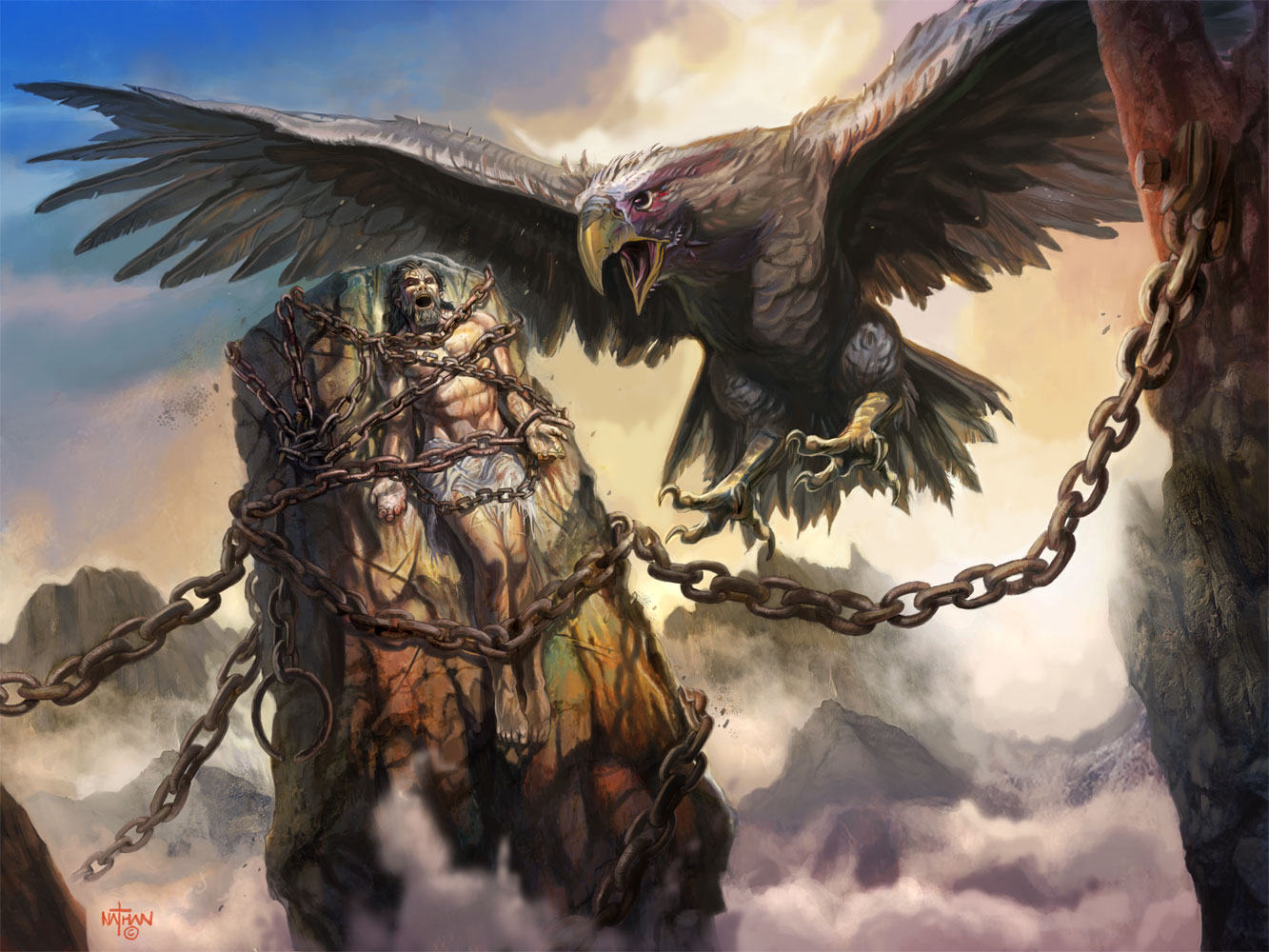
"Prometheus Chained" by Nathan Rosario

Prometheus was sentenced to being chained to a mountaintop for the end of time. There, an eagle would come each day and eat his liver. Then, overnight, his liver would regrow, like Wolverine from the X-Men, to be eaten horrifically the next day.

Satan, on the other hand, was cast out of heaven and condemned to Hell, a place that's just awful because you don't get to fawn over God and Jesus and friends. But ignoring a few recent "soft Hell" submissions from apologist ideation, most descriptions of Hell utilize fire, brimstone, and ironic forms of sadistic punishment on those who sinned in life. Hell is a place akin to the torture of the eagle.

Eventually Zeus, growing soft as years went by, relented on Prometheus' torture and sent Heracles to rescue him and shoot the eagle with his arrows, dipped in the poisonous blood of the Lernaean Hydra. God, on the other hand, has not seemed to forgiven the Devil for his war against Heaven (or whatever).

So Zeus, usually described as both capricious and jealous, is apparently a softer deity than Yahweh.

More Punishment: Femme Fatale

Here the chronology differs, but the essence stays eerily similar.

Prometheus: 

Before Zeus softened up, he knew how to hold a grudge, and felt that mankind needed to suffer for Prometheus' gift of fire, a gift that could not be revoked once given. So he devised a "gift": a wife named Pandora, the first woman. She was given to Epimetheus, Prometheus' brother (who somehow sounds like a human being... don't ask) to be his bride. Zeus made sure that she was given all sorts of gifts from the other Olypmian Gods-- including curiosity. Zeus also gave Epimetheus a box (or, originally a jar) containing all the Evils of the world that would never plague mankind-- they were under his protection. Pandora was told to, you know, stay away from the thing.

http://www.cgarena.com
Naturally, the curious Pandora could not help herself, and one night she opened the box. Out exploded all the evils of the world-- famine, disease, plague. Pandora slammed the box shut, and a small voice from inside cried "Let me out too! For I am Hope!" Hope had been locked up with the other evils, to provide for humanity against all the other ills. Whether Hope makes it out or is stuck in the Box is never explicitly said, and depends on how pessimistic your interpretation might be. Or you might consider Bane from The Dark Knight Rises, who claimed that no true despair can exist without Hope.

Abrahamic Religion:

Eve is created by God from one of Adam's ribs (a reference to a condition where women sometimes, not always have one extra set of ribs-- approximately 0.2%-0.5% of the population, most being women).

God does this to keep Adam company, because being single is terrible. So while they're chumming around the Garden of Eden, they've been forbidden from eating from the Tree of Knowledge. A serpent suggests to Eve that she should, and curiosity and innocence get her-- she eats of the fruit, and has Adam do the same. And they are cast out of the Garden of Eden, into the cold, harsh world. In this case, Satan is doing the tempting, but it is God who punishes the formerly innocent (who realize their nakedness) and banishes them from paradise on Earth.

To Be Continued....

Sunday, September 8, 2013

Breaking Bad Recap: To'hajiilee

Halfway through the last "half" season, Breaking Bad is digging up the past, and getting ready to bury the present.

Tonight's episode, which shall only this once be referenced as "To'hajiilee" for spelling reasons, opens with Todd & Company. There is a cute, subtle anti-smoking piece, where Todd recommends that Uncle Jack wear a mask as to not breath in toxic fumes; he repeats his sentiments about precaution (mirroring the previous episode in which he bemoaned the nanny state) and asked Todd to hurry up so he could go smoke.

Todd, hurrying, takes out his meth: not cooked but in its final stage. It currently holds a 76% purity: an improvement, although (as Lydia there points out) marginal. But a bigger problem is that it is not blue. Blue is the brand. It was Fring's Blue, Hiesenberg's blue. They're willing to dye it, like farm-raised salmon or something, and Todd thinks he can fix it the right way by following Mr. White's teaching. Lydia is nervous about all of this (what's new) but is expresses her somewhat desperate faith in Todd. Todd offers to have Uncle Jack "straighten things out" with people pressuring Lydia, which she politely declines. There are some funny moments in this set of scenes:

1. Arguing whether or not the not-blue meth looks a tiny, itty-bitty bit blue. Maybe aqua-marine? Color fight!
2. All the guys are checking out Lydia. Kind of creepy.
3. Todd's ringtone is "She Blinded Me Science". Apparently Walt's teaching has inspired him into the halls of geek.

Awesome. Cut to Breaking Bad intro.

Then we move to the Hank-Jesse-Gomez out-brief, following the disastrous non-meeting that took place at the end of last meeting. Jesse points out that Walt would never destroy his money, and knows someone who might know where Walt's money is. Then there's some mischievous photo work with some steak for Jesse's brains.

Next we quickly see that Hank and Gomez have obtained Huell, our favorite bodyguard. The DEA (unaware about Walt still, naturally) has "encouraged" him to stay at their place, while he is absolutely not under arrest. Then they fool him into thinking that Jesse had been executed with their steak-brains Jesse pic. They sell a tale of Saul selling out his henchmen, and Walt trying to tie up loose ends. One of these loose ends, you might recall, is the poison cigarette being taken from Jesse, something with which Huell absolutely did have something to do. Huell, upset at seeing Jesse's "body", spills the beans that seven barrels of money went off in a van, not knowing where but knowing the van came back dirty. He also shares that Kuby rented the van from a specific place, a place that USED to have GPS (but doesn't anymore, as it turns out-- more on that soon). Huell is told not to try to call Saul through nasty intimidation tactics-- calling Saul would lead to his death, as far as Huell knows.

Walt is meeting with Todd and Uncle Jack, where we find that Todd doesn't have too high an opinion of Jesse's badass level (although that might have been different if he had any idea about Jesse's part in the Cartel Extermination in "Salud"). The Aryan boys want Walter to cook with Todd, since any money he offers pales in comparison against what they could make cooking his meth. Walt reluctantly agrees to do ONE cook-- after the job is done. Uncle Jack says they could kill him tonight if he wants-- just let him know where he is.They're willing to kill on a dime, and for nothing more than some Walter White tutor time. These are not people you want to mess with-- they're proving themselves as scary as the cartel ever was, but with less drama and more down-to-business. Walt doesn't know where Jesse is, but he thinks he can flush him out.

Walt goes over to Andrea's place, and sees Brock once more. Always an awkward meeting between these two-- always adding mystery to how he got poisoned in the first place. Walt gets Andrea to call Jesse, using Jesse's "using" as an excuse for extra concern. Of course, the Aryan boys would have been waiting for Jesse, who would have died before he knew what was happening (the way Walt intended). Lucky for Jesse, who probably would have fallen right into THIS trap, Hank intercepts the message that Andrea leaves. Nice try, Walt.

Hank comes back after finding out that the van rental does NOT have GPS on it that tracks all its movements-- ACLU lawsuit or something. But Walt doesn't know that.... a trap!

Walter Jr. is working in the car wash, wishing everybody an A-1 day. He asks what we all ask: why say that? But it reinforces their brand. Saul comes in, and has to PAY FULL PRICE at the car wash. Jr. recognizes him from the commercials, for which Saul has good humor. Saul's bruises are still showing-- occupational hazard. He gets a great Saul line: "Don't drink and drive... but if you do, call ME!"

Saul. I love you. Saul, however, is not feeling the love, despite his big ol' billboard in the background-- Huell is missing and Saul is worried that Jesse has him. Radio silence. 

Jesse photo-texts a picture of one of the "barrels" of money, and tells Walt that he found six more.Jesse tellsWalt that he will be burning 10,000 a minute until Walt meets him where his money is, AND he can't hang up on him to try to get help or something awful. Walt tells Jesse that his cancer is back, and the money is for his children-- "CHILDREN? Are you seriously going to go there" is Jesse's reasonable response.

Walt tells Jesse that all the murders he did, he did as much for Jesse as for himself. It's not true-- except for the gang-bangers, who Walt totally killed mostly for Jesse. That's the one weird fly in the Breaking Bad ointment that's always been confusing-- why not just let Jesse die then? But Walt is paternalistic towards Jesse, who he still thinks is too stupid to see that he was trying to help. With friends like these, who needs enemies.

Walt arrives, and quickly realizes he's been conned. He starts scoping out different positions-- in part to see anyone coming, and in part to make sure no one is already there. He calls the Aryan guys, and tells them the coordinates of the place. He sees Jesse, who he would have approached violently himself-- but then sees that Hank and Gomez are with them. Check. They see Walt's car. Check. He lets the Aryans know--nevermind, Hanks is there and he is off limits, so the hit is off. Check. Hank eventually gets Walter to step out, and puts the man in handcuffs. Checkmate. Hank got 'em.

But this is Breaking Bad, and there is always another move for the king. 

Walt is in handcuffs, and calls Jesse a coward (who then goes full Flavor of Love and spits on him). Hank calls Marie, and tells her the good news and that he loves her (that can't be good). They put Jesse and Walt into different cars and get ready to drive off....

...And, of course, here come the Aryans. Armed to the teeth, and their guns are quickly aimed at Hank and Gomez, who return a firing stance aimed opposite.

Open fire. Bang, bang bang. Hank and Gomez seek cover, Walt and Jesse duck in their respective cars. Bullets are whizzing around everywhere.

End!

No, that can't be the end! I won't make it... another... week... GAHH!

Final Thoughts:

1. Tough Aryan guys having a color fight reminds me of Steve Buschemi during Reservoir Dogs, probably an intentional reference.

2. The barrel photo was in the backyard for Hank, where the dirt might not match, but Walt would be too freaked to notice. Where they BBQ'ed plenty of times.

3. It's the first place Walt and Jesse ever cooked. We knew that, but still-- very sweet, Walt. 

4. Hank having a sweet, tender "I love you" moment with Marie is a TERRIBLE thing for Hank, because this is Breaking Bad and it kind of sets him up for an entirely appropriate death. A death where he got his final goodbye to Marie in-- in a way. "Why is there what looks like brains in our garbage can?" might foreshadow Hank's brains getting thrown out of his skull very soon.

5. I thought Gomez had a good chance of surviving to the end, but it's not looking too good for him either right now. So far so good, though. As the actor said in the post-show talk, he's the one guy who never broke bad. He also got a "good job, buddy" in-- another sweet moment that might mean he's soon to be toast.

6. Walt was trying to warn Hank when the Aryans showed up. But what was he really going to tell him?

Tuesday, September 3, 2013

Papal Pacifism & Wishful Thinking

This post might come across as condescending to serious Catholics, particularly those who assume that Papal infallibility is a subject worth respecting. It is. Unapologetic warning in advance. Bill Donohue, stop reading.

The American zeitgeist seems to be shifting, at least slightly, towards a state of dawning awareness that the United States is on the verge of joining other nations in combat in Syria. The familiar faces of the Congressional House and Senate have begun debate, and old allegiances and rivalries are being challenged. Rand Paul is praising President Obama's tepid but Constitutionally valid decision to seek Congressional approval (which is seems like a weak move, given that the country is used to blanket unilateral statements from the White House on issues of national security).

As put to a friend: Obama-hate is compelling war hawks to be anti-war, anti-war folks are becoming anti-Obama, John McCain is agreeing with President Obama, and Senator Lindsay Graham still has a girl's name. BLACK IS WHITE, NIGHT IS DAY!

But regardless of the thoughtful debate, one person's opinion on the situation in Syria seems entirely based on wishful thinking. An opinion entirely built upon faith that things will work out, despite a dire lack of evidence. A position of foolish naivete. How... entirely... out of character, for this individual. Yes, the man whom is being described is none other than Pope Francis, Jorge Mario Bergoglio.


Pope Francis, to his credit, has condemned chemical weapons. This is admirable, and morally sound. Point in fact, Francis has taken a moderate approach to his office, at least if reports by the press are to be trusted. A few statements he has made have shined of genuine humanistic morality, untarnished by the dogmatic poisoning of an organization that claims to have a monopoly on ethics (it doesn't). Naturally, several of these statements have been walked back later by the organizational bulwarks that fervently oppose anything substantially new.

If this author was to choose a general impression of this Pope (nourished and encouraged by the media) from a non-Catholic perspective, the word chosen would have to be "sweet." Condescending & dismissive, certainly, but an adjective nowhere near as severe as the words his predecessor bring to mind: "revolting", or "morally compromised" are tame examples.

Sweetness is once again reflected on his attitude towards Syria. Despite his condemnation of the use of chemical weapons (an ethical slam dunk for pretty much anybody), he is calling for a "negotiated settlement" with the Assad regime. His statement today, a departure from the "spiritual" message that is the norm, was heartfelt, earnest, and innocent as a virgin (presumably an apt analogy). And it was about as profound as "Give Peace a Chance"-- far from Lennon's most insightful song.

Meh.

Some excerpts include:

"Using violence can never bring peace. War is war. Violence is violence."

"There is judgement of God, and judgement of history upon our actions... from which there is no escaping."

Pope Francis went on to call for a day of fasting and gathering in St Peter's square, open to believers and non-believers, to "invoke" (pray?) the "gift of peace" in Syria. The sentiment is sweet. It truly is. But it's got the same degree of geopolitical seriousness as an eight grade ethics paper.

The idea that Assad, an Alawite follower of Islam, gives half a damn about the Pope's invocation for peace is wishful thinking at its most hapless. This is one big difference that separates this kind of non-violent demonstration to that utilized in the Civil Rights era, or from Mahatma Gandhi's efforts: demonstrations then would immediately and directly be seen by the oppressors. Interesting fact: Gandhi had the nickname of Bapu, which means "father"--  the same word, in Italian, is the etymological root of the word "Pope". This "father" is going to be ignored.

Pope Francis' predecessor opposed entry into Iraq, a war of choice that the United States entered and created ill will in the international community. This author believes this was the correct call. And admittedly, as previously discussed, the situation in Syria is complicated and dangerous. All nations and all parties must keep sober minds when looking at what actions should be taken.

But looking skyward, and asking the heavens to resolve our issues? This is the attitude of children, not adults. This is in no way a serious examination of what moral obligation the developed world has in problem areas, where innocent collateral damage is tallying upwards.

It is doubtful that if President George W. Bush had been a practicing Catholic, the Pope's condemnation would have deterred him in the least. Who knows? Theologians are not operating in the land of mortals, and are seeking divine commands from books written by preindustrial fanatics. When push comes to shove, shoving will occur when it is convenient or, more optimistically, when it is necessary. Cardinal Adolf Bertram, in 1933, refused to intervene with Jewish segregation and the earliest stages of the Holocaust; Goebbels on the other hand was excommunicated for the ugly crime of marrying a Protestant. Looking for ethical guidance from these sources is not serious business.

One of the key problems here is that violence can, in some cases, be justified. Were an ethical person to see a child being beaten to death, would it not be that person's duty to intervene by any means necessary? All too often, children provide us both the moral excuse and simplification of ideals; we value protecting those who so easily qualify as innocent. That is, on a geopolitical scale, what the situation is in Syria. Granted, the reality is more complex than the analogy, and ethical duties are ill confined to simplicity.

Another vital critique of Pope Francis' perspective is that the expectation of Divine Justice to divvy out reward and punishment fairly is absurd. Should we abandon all laws? For after all, in the end will not God's Judgement make everything right? Deep down, all but the most dangerously zealous fear empty skies and dead heavens; maybe that's not an irrational fear. It might be nice to imagine Hitler burning in hell, but more likely his fate of nonexistence is no different from that of John Paul II. Sadly, police are needed on this planet, because the REAL world matters and the effort to achieve moral victory should not be delayed to future planes of existence.

Is it invalid for Pope Francis to express his opinion on Syria? Is it unreasonable for him to have concerns about violence being exacerbated by intervention? Certainly not. But to imagine that a show of Christian faith with produce some kind of Jean Valjean revelation to a Middle Eastern despot seems silly. Maybe it's no sillier than imagining that one man is a better conduit for God's Will than anyone else, and that person is elected by men who dress like red birds.

But hey, here's hoping it works. Prove me wrong.

Monday, September 2, 2013

Breaking Bad Recap: Rabid Dog

Albuquerque, New Mexico is a dog-eat-dog town, in Breaking Bad this week. And at least one of those dogs is rabid.

The episode, interestingly, begins with Walt. Not Jesse, who we last saw pouring gasoline all over Mr. White's floor in a complete rage. Walt is cautiously approaching the house with his gun, clearing the corners and checking everywhere. The gas is immediately obvious. But lo and behold-- Jesse did not burn the house down, and seems to have completely disappeared.

But his CAR is still outside. Where could he be? Well, actually it's Saul's car, but that's besides the point. Walt finds a CD-- is it Hank's "DVD Confession" that Walt made? That was my first thought, although I believe that is incorrect. However, it certainly does foreshadow that there's a good chance that Hank, who dipped out of the office late last episode to unknown destinations (after Gomez said his men were going to stop following Jesse) has something to do with this. And that probably bodes very poorly for Walter White.

Cue Breaking Bad intro.

It amusingly reopens to Walter working on creating a cover story for why the house was broken into and now smells like gas. He offers to pay the vacuum folks, but they politely (and honestly) say that while they'd like to accept more money, gasoline is tricky; it's soaked into the floorboards or sub-floor or whatever. Meanwhile he wants the keys replaced, but without changing the locks.

So it's time for another Fugue state type deal. Walt peculiarly pours gasoline on his clothes, tosses the gas into a trashcan, changes his mind and retrieves it, and pours some on his car seat as well. Late that night (after the car wash is closed, presumably) Skyler comes in and-- err-- is that gasoline? And Walt goes into "storytelling" mode. There was a "pump malfunction" at the station, and he left his gas-soaked clothes on the rug.

Walter Jr. calls bullshit-- but then provides Walt with a BETTER lie-- Walt fainted while pumping gas, right? Stop lying, Walt! Walt accepts this excellent, excellent out gracefully, denying it but also admitting that his head got  a little "swimmy". Skyler just kind of rolls with it, used to Walt's nonsense. Because of the smell and fumes, the White family decides to go to a hotel for the night.

Walt meets Saul outside the hotel; they don't know where Jesse is, despite Kuby bugging Skinny Pete and Badger (who Walt mistakenly thought was nicknamed "Beaver") and hearing hours of fan talk about Babylon 5. Saul is particularly grumpy after taking his beating from Jesse, but he's still funny as ever. Walt says he wants to talk to Jesse when they find him. Saul and Kuby exchange a look of skepticism, and ask what should happen if Jesse isn't in the mood for discussing "the nuances of child poisoning". Saul, taking the punches quite personally, asks Walt if they should take notes from Old Yeller and put the good ol' dog, now rabid, out of its misery. Walt balks, and angrily demands that Saul never float that idea again.

When Walt comes back with ice, Skyler asks how Saul is doing. After a short denial, Walt drops his bumbling husband routine and flatly asks/says "I'm sorry, were you spying on me.." Skyler is feeling tired of the weak-sauce lies that she is too adept at seeing through, and confirms this in a businesslike way. She then wants to know the real story about the gasoline, and Walt (with some qualifying statements about their safety, and the fact that Jesse changed his mind). Then Skyler goes FULL LADY MACBETH. SHE, Skyler White, the "victim" of Walter White, recommends that Walter "TAKE CARE OF IT" in a final, Old Yeller way. Don't talk to the kid and make him "see reason". What if he changes his mind back. She wants finality. Unbelievable. After the tape to Hank and Marie, Skyler finally knows what it's like to be in too deep to back out, just like Walt found himself in the first episode, lethally defending himself.

Then, halfway through the episode, we return to Jesse, and we get to see his side of the story. As he is pouring gas on the carpet, Hank interrupts, saying that they will "burn him down" together. They drive off the second Walt pulls up at the end of the street, leaving the trace of Hank's involvement with Jesse.

Marie is at her therapist, who seems to be under the impression that Marie is being the regular overreacting  woman who has bursts of kleptomania, not knowing that her anger towards Walter is largely deserved. She speaks cryptically to the guy, and recites poisons she has looked up online that would serve as just punishment. He tiredly reminds her that violence is not the way to go, and may even smell out that there is more to this situation than regular run-of-the-mill crazy.

When she gets home, Hank has bags packed for her-- purple luggage, naturally. Marie stubbornly refuses to leave until Hank tells her that Jesse is staying there. Marie is OK with it, on the condition that Jesse being there is bad for Walter.

Walt has a tender moment with Jr, which is cute but not particularly noteworthy.

Marie and Jesse finally meet each other, for what has to be the first time. She offers coffee, and Hank has set up a video camera with GOMEZ! He's up to speed on things at long last, which is great: Hank needed his partner, and they're a great team. Which he proves: he reminds Hank that even with a Jesse confession, it's just one confession against one denial, and no real evidence.

After taping the confession, Hank uses the message that Walter left for Jesse, wanting to explain things to him, and proof that Walt actually cares about Jesse. Jesse should meet Walt and wear a wire. Jesse is afraid that it might be a trap to kill him. Hank doesn't think so, but tells Gomez that he truly doesn't care if Jesse dies: it would provide evidence on Walt. Yikes.

The meet is set up, but Jesse starts freaking out when a tough-looking guy is standing close to Walter. Time reveals that of course, it's just some random dude waiting for his daughter. He walks off to a pay-phone, calls Walt, and tells him that he's gunning for him. Hank is furious, but Jesse alludes to the fact that there is a different, better way to take down Heisenberg.

Meanwhile, Hank calls Todd-- looks like he has another job for his Uncle Jack.

Final Thoughts:

1. Skyler is officially Lady MacBeth. Did Lady MacBeth live or die, in the end? The latter, offstage...

2. Why is tough guy so tough looking when he's not with his daughter?

3. Hank is a total dick now, for being so unpleasant towards Jesse, who is MAKING the entire case for him. And saving him from the counter-accusations.