... Continued from Part 1.
To summarize, we have a devious god-entity that rebels against the Chief God, brings a gift to humanity (which, in turn, ultimately curses them) as brought about by a woman.
Are they precisely the same? Yes? No? A little bit? It makes sense if you consider both characters in an evolving mythos, similar to Batman. Comics, TV, animation & film from the 1940's through the 2000's have used the Batman: they capture the same essence but the surrounding mythology adapts to the times. Shark repellent, sadly, will eventually expire.
The answer is not that there is no morality, nor that we must lose ourselves to the unnavigable seas of moral relativism. Instead, it is more wise and of better moral soundness to embrace the truth of the matter, and appreciate the stories as fables. Few wars have been led over Aesop.
To summarize, we have a devious god-entity that rebels against the Chief God, brings a gift to humanity (which, in turn, ultimately curses them) as brought about by a woman.
Are they precisely the same? Yes? No? A little bit? It makes sense if you consider both characters in an evolving mythos, similar to Batman. Comics, TV, animation & film from the 1940's through the 2000's have used the Batman: they capture the same essence but the surrounding mythology adapts to the times. Shark repellent, sadly, will eventually expire.
 |
| Different skins of the same Batman, as seen in Batman: Arkham City, showing the different stages in the character's evolution |
 |
| And Adam West, using Shark repellent |
This is not citing Batman for the sake of Batman-- although that is a valid argument, because... Batman. There is a point here.
But imagine: in the 70+ years of exploring America's favorite superhero (sorry Kal-El). The character has been written, discovered, reimagined, revamped and retooled.
Then compare that timescale to the legacy of Greek & Christian mythology/theology: thousands of years in which tales are retold, retooled, perfected. We know that the Romans directly borrowed from the Greeks for their mythologies: the similarities between Zeus and Jupiter are so blaring that no one pretended that were were different Gods throwing different lightning bolts in between civilizations.Some day in the future, perhaps historians will note the way the King James translation of the Bible "borrowed" the same scripture from its Latin, and before that, Aramaic/Hebrew roots.
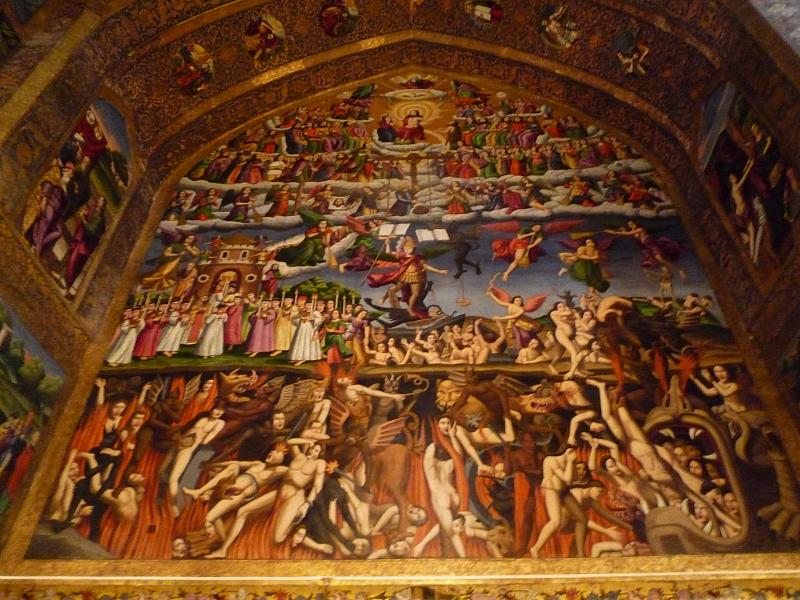
The proof is in the art & literature that is used as Christian poetry. Dante's Inferno has a space for Medusa and the Furies. Figurative poetry for the eternal torments? Perhaps, but does that not tread a dangerous line between fantasy and, er, "reality"? Sisyphus himself, pushing the boulder up an eternal hill, is one of the crisper images that Hell provides. He grossly predates Christianity.
 |
| from "http://en.wikipedia.org/wiki/Allegory_of_the_long_spoons" |
So what are the implications?
Some Christians, particularly of the Fox News variety, take exception to the God of the Bible being referred to as the same Allah in the Quaran. Why is that? Because the Quaran is not Biblical canon. Similar to the Greek/Roman dilemma, the objection is not raised with Judaism, because Christianity simply added on to the books from the Old Testament, and gives accounts from four apostles.
But if a character from the Bible, which the pious and devout hold to be divine words provided and inspired in Man, are clearly based on fictional mythologies... that is a question that needs to be addressed. Is there a Devil, or isn't there? And if there is not, then why would there be any danger of falling into sin, if sin is as imaginary as its chief harbinger?
 |
| http://www.newcovenantgrace.com/how-to-deal-with-a-sin-problem/ |
The answer is not that there is no morality, nor that we must lose ourselves to the unnavigable seas of moral relativism. Instead, it is more wise and of better moral soundness to embrace the truth of the matter, and appreciate the stories as fables. Few wars have been led over Aesop.
Moral victories are difficult when embracing the "here and now" as the only realm of concern. No cosmic ears to hear our plight, no kindly eyes staring down. But how kindly would deaf ears be, that reject prayers? Were all unanswered prayers too selfish?
But these are victories, once won, worth winning. What is the best, most moral path? Perhaps there are two. Which is the best way north might have different answers, depending on the situation, but there are incorrect answers, such as heading south. Yes, if someone travels south long enough they may reach a place where it is no longer to go further south, and North is the only option (the bottom pole). And that's the point, the proof that cries of relativism are vapid: Sam Harris writes that if there is a polar "worst possible misery for everyone" them any step away from it is a step in the right direction. Sam Harris is walking the right way there.
There may be some who are unconvinced that the alignments that have been outlined are meaningful, or that they're applicable enough to cause a crisis of faith. To that, this question must be answered: what Rosetta Stone must be provided to convince you? What Dead Sea Scroll, what possible Gospel of Judas will prove suitably damning? That is the real crisis of faith: the convergence between an elegant leap and a gullible stumble.
Would a revelation by the authors of the Bible be sufficient? It was Miriam Ferguson who allegedly said in Texas, "If English was good enough for Jesus Christ, it ought to be good enough for the children of Texas." Derided, because clearly this is ignorant in the extreme. This woman, by the way, was governor of Texas, and sadly Texas does not seem to have progressed much further with the likes of Rick Perry. The point being: leaps of faith have a dangerous way of overriding our other faculties, and reducing or level of scrutiny on extraordinarily broad and important claims.
The commonalities overwhelm this author's sense and sensibility, but it may be fair that the case is not compelling to all. After all, Satan tempted Eve after his battles with God, while Prometheus' gift of fire came while he was still on relatively good terms with Zeus. But does it not at least give pause that these events are startlingly similar? Am I the only one who sees this? I FEEL LIKE I'M TAKING CRAZY PILLS HERE!
It's generally regarded as taboo to criticize religious beliefs, but such taboo does not seem to be in place for criticizing mythological tales. So perhaps these analogies can serve as more than filler for a Venn Diagram demonstrating certain correlating attributes. The fundamental elements of the stories need to be examined, and appreciated for what they are; then and only then can they be taken down from the pedestal of Biblical inerrancy. As written on previously, fictional stories hold plenty of value and can teach profound truths. But appreciation of what is fiction-- that is the fruit of the Tree of Knowledge.

No comments:
Post a Comment